


Sapient Insights Group’s research conducted in 2024 across more than 3,300 organizations with 24 million employees once again proves the importance of HR’s strategic impact in organizations:
Companies that have a strategic HR function achieve 34% better business results, including greater profitability, innovation, market share, and customer satisfaction. Proven.
However, only 52% of organizations see HR as a true strategic partner that contributes to the value of the entire system. The rest: 30% are rated as “almost strategic” – they only have an impact on a few leaders, and 18% are reduced to transactional activities, legal compliance, and administration.
Global picture vs. local reality
Our small survey on LinkedIn showed that only 32% of HR professionals in the region feel that their role has real strategic impact.
That is 20 percentage points below the global average, which suggests that HR in our country is still struggling for legitimacy and influence at the management table.
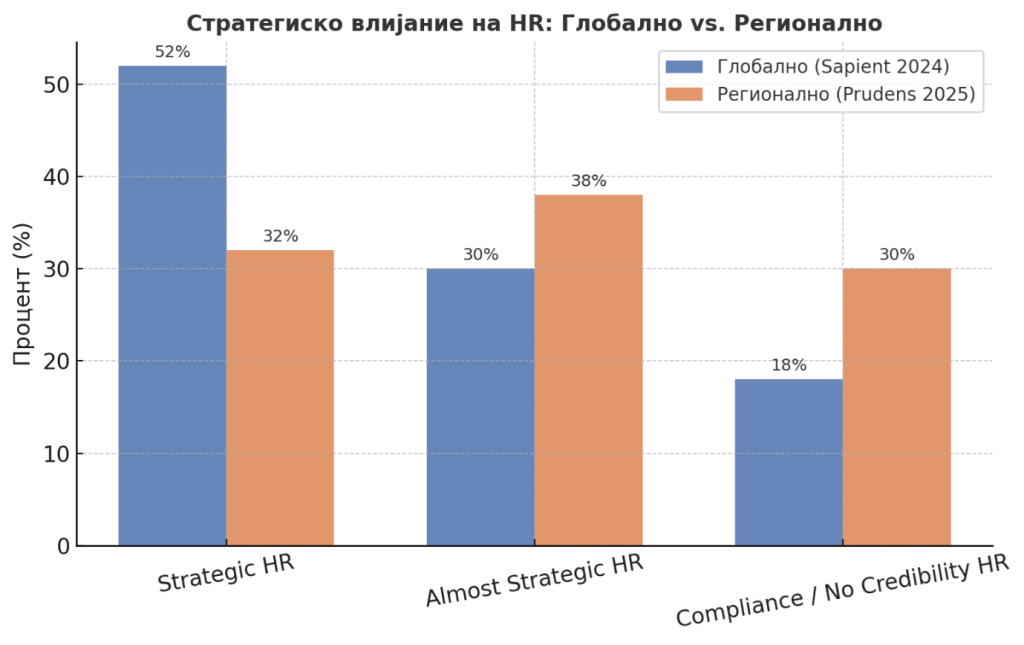
HR teams in Macedonia and the region are evidently gradually moving towards the strategic spectrum – half are already moving towards higher influence, but only a third truly have an equal role with management, and 30% remain still perceived as administrative and process support. This indicates that the transition to strategic HR in our region has begun, but the understanding of the role of HR in organizations is still not at a satisfactory level.
What does a strategic HR function actually mean?
When we say that HR is a strategic partner, it doesn’t just mean the presence of the HR manager at management meetings. Strategic impact will be visible when everyone in the organization unanimously confirms that HR directly impacts the growth, profitability, and future of the company – through the people, structures, and culture it creates.
A few clear indicators that HR truly has a strategic role:
- Company strategy and business plans contain clearly defined HR goals.
When a company defines where it wants to be in three or five years, HR simultaneously defines which people, skills, and systems will get it there. - HR plans long-term, not reactively.
Instead of reacting when there is a shortage of people, HR plans capacities and scenarios for the future of work in advance – what jobs, technologies, and competencies will be needed to achieve the company’s vision, at least 3 years in advance. - Business decisions are made based on HR data.
When planning for growth, automation, or expansion, HR provides relevant data on productivity, engagement, attrition risk, and talent availability. - Managers see HR as an advisor, not just a service.
HR is a leader in organizational redesign, leadership development, and creating a culture that supports innovation and accountability. - There are clear KPIs that measure people’s impact on results.
It is not just activities (training, turnover) that are measured, but effects – how much talent development and retention affect profits, growth, or customer satisfaction. - HR leads the organizational change agenda.
In every transformation – new technology, new structure, or strategic pivot – HR manages the process of adaptation, communication, and competency development.
Recommendations for organizations and managers
- Don’t skip HR when making decisions.
Include him in all strategic conversations about growth, market, structure, and budget. HR should be part of the decision – not just informed after it is made. - Don’t overlap roles and influence.
Everyone thinks they can influence decisions related to people. Respect the division: HR is the systemic carrier of people, leadership, and culture. Without his participation, any intervention could potentially create a problem. - Set HR goals as an integral part of your business strategy.
In annual and long-term plans, define HR goals that are directly linked to results – productivity, profitability, retention, development of critical skills. - Introduce HR metrics and regularly monitor them in management meetings.
The same weight given to sales or finances should be given to people metrics – engagement, turnover, performance, internal mobility, leadership maturity. - Everything HR does is an investment, not an expense!
Every movement, feeling, dissatisfaction, attitude, or departure of an employee costs you a lot of money. Don’t skimp on the system that should prevent losses.
Recommendations for HR professionals
- Set HR goals that are part of the business strategy and plan for the long term.
Your goals should stem from business priorities and anticipate the company’s future needs – people, skills, structures, and culture – at least three years in advance. - Build analytical literacy and use data in every decision.
People analytics, trends in productivity and engagement – it’s the language that puts you on par with finance and sales. - Learn constantly – and topics beyond classic HR.
A modern HR leader must understand technology, organizational design, data, and automation. They are the tools that allow you to speak to management on an equal level. - Develop partnership and influence among managers.
Don’t just be a support and assistant, but become an advisor who helps solve business problems through people. Build credibility with consistency, evidence, and the courage to demonstrate a clear stance and influence.
How can Prudens help strengthen the strategic role of HR in your organization?
When a company lacks strategic HR knowledge or structure, it doesn’t have to be an obstacle – knowledge can be borrowed.
Prudens helps organizations set up a stable, measurable and impactful HR system through practical solutions:
- HR Audit & Strategy Alignment – a complete assessment of the HR function and alignment with business goals.
- Synapse HR Intelligence Platform and HR KPI Framework – integrated analytical support for real-time KPI monitoring, productivity and engagement, with a system for long-term skills and capacity planning.
- Leadership development programs – strengthening managerial maturity, influence and a culture of accountability.
- Training and development of HR teams – building analytical literacy, people strategy and organizational design competencies.
Нашата улога е да им помогнеме на компаниите да го претворат HR од „процес за поддршка„ во стратегиски лидер – двигател на резултати.
Check out all our blog posts
Benchmark source: Sapient Insights Group, Leveling the Playing Field: Unlocking Better Business Outcomes by Elevating the HR Role (2024) – 3,318 organizations, 25M employees, global sample.
Result from Prudens survey (2025): only 32% of HR professionals in the region feel real strategic influence.