


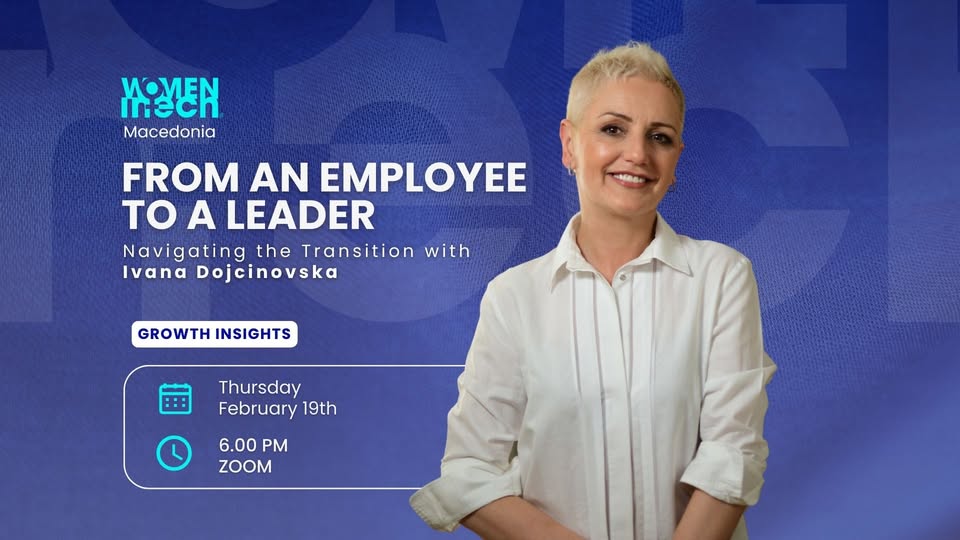
The transition from an individual contributor to a leadership role is perhaps the most profound transformation a professional can undergo. For Ivana Dojchinovska Stojanovikj, this journey wasn’t just about a change in title, rather it was a fundamental shift in how she perceives herself and her impact on others.
In the interview, Ivana opens up about the “mirror effect” of leadership, the struggle to let go of the expert ego, and why the most powerful tool a leader possesses isn’t an answer, but a question.
The House of Mirrors: When Leadership Becomes Personal Growth
“My steepest growth curve happened the moment I stepped into a management role,” Ivana shares. Before that, as an employee, she describes having the manager as her only “mirror”. Feedback was direct, and her focus was narrow: deliver results and be the best at her craft.
But leadership changed the landscape entirely…
“Suddenly, I felt like I was standing in front of multiple mirrors at the same time. Everything you do becomes visible. Every word, every decision, every reaction. It’s no longer just about the results, but about the way you achieve them.”
For Ivana, leadership became a process of stripping away the ability to hide behind technical expertise. It forced her to confront her own habits, fears, and automatic responses. Today, she views leadership as a continuous process of building self-awareness and radical responsibility.
The “Expert” Trap: Letting Go to Level Up
According to Ivana, the hardest part for new leaders is realizing they must give up the very role they were best at. Most new managers are promoted because they were stellar, productive experts. Naturally, they try to bring that same “fixer” energy to leadership.
Then, they fall into the trap of trying to control every detail, unaware that they are getting themselves stuck in between two worlds. Ultimately this leads to an overwhelmed leader, a demoted team, and a nagging sense that there is something wrong.
“The first few months of leadership aren’t actually about learning new techniques,” Ivana explains. “They are about a fundamental shift in identity—moving from ‘I execute’ to ‘I empower.’”
The Myth of the “All-Knowing” Leader
The most toxic belief a new leader can hold is that they must have all the answers and that they must know more than everyone else. This creates immense pressure, leading many to act confident even when they aren’t, or to make isolated decisions to avoid looking weak.
“Leadership doesn’t mean being the smartest person in the room. It means creating the room where others can think, take responsibility, and grow.”
Ivana points out that when a leader tries to know everything, the team stops thinking. A leader’s true strength does not lie in the answers they provide, but rather in the quality of the questions they ask.
Leading Without a Title: Influence in Flat Structures
Leadership doesn’t start with a promotion, it starts with behavior. In flat structures, where hierarchy is secondary, influence is built through credibility and action.
Ivana believes that “titleless” leadership is most visible when things go wrong. While others might wait for permission or direction, a natural leader takes initiative.
How to lead from any position:
- Take ownership: Focus on solutions rather than just identifying problems.
- Be a point of stability: Bring clarity and calm during moments of uncertainty.
- Build trust: Influence comes from the ability to connect people and foster collaboration.
“This is the kind of leadership that is usually recognized by the team first,” Ivana concludes, “and only then by the organization.”
Originaly published on womenintech.mk blog
Check out all our blog posts